Monday, May 18, 2015

10 Reasons to Lift Weights!

Many women believe that the only way to lose weight is to do cardiovascular (aerobic exercise). So they jog or take aerobics classes five times a week. Eventually, though, they notice that while their bodies are a little smaller, there are still a lot of flabby and jiggly bits. Sound familiar? Aerobic exercise is important for good health, but it’s only half of the equation. Keep reading for the other half.
For optimal fitness, longevity, and a lean body, weight training is essential. If you avoid pumping iron because you’re afraid of getting “bulky,” then you’re missing out on one of the best fat-burning methods around.
When you’re weight training, you shouldn’t rely exclusively on the scale to gauge your progress. You can use a body fat tester or a tape measure to track how many inches you’re losing. The size of your body will shrink as you shed fat and build muscle, but your weight may not change as dramatically as you expect. Besides, what’s more important, the number on the scale or how you look in your skinny jeans?
If you’re still not convinced that you need to lift weights, here are 10 reasons you should reconsider.
1. Burn more fat. Researchers at Tufts University found that when overweight women lifted heavy weights twice a week, they lost an average of 14.6 pounds of fat and gained 1.4 pounds of muscle. The control group, women who dieted but didn’t lift weights, lost only 9.2 pounds of fat and gained no muscle. When you do an intense weight-training program such as ChaLEAN Extreme, your metabolism stays elevated and you continue to burn fat for several hours afterward. During regular cardio exercise, you stop burning fat shortly after the workout.
2. Change your body shape. You may think your genes determine how you look. That’s not necessarily true. Weight training can slim you down, create new curves, and help avoid the “middle-age spread.” Just look at the amazing body transformations of the women who’ve completed P90X. Dropping only 3 percent of your body fat could translate into a total loss of 3 inches off your hips and thighs. And no, you won’t bulk up—women don’t have enough muscle-building hormones to gain a lot of mass like men do. If you keep your diet clean and create a calorie deficit, you’ll burn fat.
3. Boost your metabolism. The less muscle you have, the slower your metabolism will be. As women age, they lose muscle at increasing rates, especially after the age of 40. When you diet without doing resistance training, up to 25 percent of the weight loss may be muscle loss. Weight training while dieting can help you preserve and even rebuild muscle fibers. The more lean mass you have, the higher your metabolism will be and the more calories you’ll burn all day long.
4. Get stronger and more confident. Lifting weights increases functional fitness, which makes everyday tasks such as carrying children, lifting grocery bags, and picking up heavy suitcases much easier. According to the Mayo Clinic, regular weight training can make you 50 percent stronger in 6 months. Being strong is also empowering. Not only does it improve your physical activities, it builds emotional strength by boosting self-esteem and confidence.
5. Build strong bones. It’s been well documented that women need to do weight-bearing exercise to build and maintain bone mass, and to prevent osteoporosis. Just as muscles get stronger and bigger with use, so do bones when they’re made to bear weight. Stronger bones and increased muscle mass also lead to better flexibility and balance, which is especially important for women as they age.
6. Fight depression. You’ve probably heard that cardio and low-impact exercises such as yoga help alleviate depression, and weight lifting has the same effect. The endorphins that are released during aerobic activities are also present during resistance training. Many women find that regular strength training, in conjunction with psychological treatment, helps lessen their depression symptoms substantially.
7. Improve sports fitness. You don’t have to be an athlete to get the sports benefit of weight training. Improved muscle mass and strength will help you in all physical activities, whether it’s bicycling with the family, swimming, golfing, or skiing…whatever sport you enjoy.
8. Reduce injuries and arthritis. Weight lifting improves joint stability and builds stronger ligaments and tendons. Training safely and with proper form can help decrease the likelihood of injuries in your daily life. It can also improve physical function in people with arthritis. A study conducted at the University of Wales in Bangor, United Kingdom, found that mildly disabled participants who lifted weights for 12 weeks increased the frequency and intensity at which they could work, with less pain and increased range of movement.
9. Get heart healthy. More than 480,000 women die from cardiovascular disease each year, making it the number-one killer of women over the age of 25. Most people don’t realize that pumping iron can also keep your heart pumping. Lifting weights increases your “good” (HDL) cholesterol and decreases your “bad” (LDL) cholesterol. It also lowers your blood pressure. The Journal of the American Medical Association reports that people who do 30 minutes of weight lifting each week have a 23 percent reduced risk of developing heart disease compared to those who don’t lift weights.
10. Defend against diabetes. In addition to keeping your ticker strong, weight training can improve glucose utilization (the way your body processes sugar) by as much as 23 percent. According to the Centers for Disease Control and Prevention, 16 weeks of strength training can improve glucose metabolism in a way that is comparable to taking diabetes medication. The more lean mass you have, the more efficient your body is at removing glucose from the blood, which can reduce complications from diabetes or even help prevent type 2 diabetes in the first place.

Friday, May 15, 2015

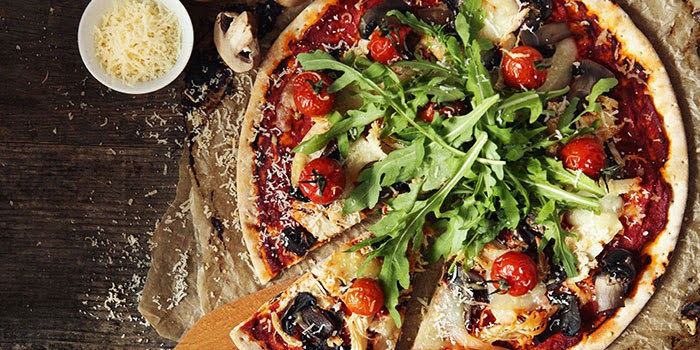
Chicken Pizza!

This healthy homemade pizza is topped with lean chicken, fresh ingredients, and a touch of Parmesan cheese.
Total Time:​ 18 min.
Prep Time:​​​ 10 min.
Cooking Time:​ 8 min.
Yield: 8 servings
Ingredients for Pizza Dough:
¼ oz​​​ active dry yeast
1 cup​​​ warm water (100–110° F)
2 tsp.​​​​ sugar
3–3¼ cups ​​​whole wheat flour, divided use
½ tsp.​​​​ fine sea salt (or Himalayan salt)​
2 tsp.​​​​  olive oil, divided use
Ingredients for Pizza:
½ cup all-natural pizza sauce, no sugar added
½ cup shredded mozzarella cheese
2 Tbsp. grated Parmesan cheese
4 oz cooked chicken breast, boneless, skinless, shredded
1 cup cherry tomatoes
¼ cup thinly sliced mushrooms
2 cups fresh arugula
Preparation:
For Pizza Dough:
1. Place yeast, water, and sugar in a medium bowl. Let stand for 10 minutes, or until yeast becomes foamy.
2. Combine 3 cups flour and salt in a small bowl. Gradually add flour mixture to yeast mixture. Mix with clean hands until mixture does not stick to your hands. Add additional flour if needed. Roll dough into a ball. Brush with ½ tsp. oil. Place in a bowl; cover with a towel. Let rise for 2 hours.
3. Punch down dough to remove air; knead and roll into a ball. Brush with ½ tsp. oil. Place in a bowl; cover with a towel. Let rise for an additional 2 hours.
4. Preheat oven to 450° F.
5. Roll dough until it will no longer stretch. Let rest for 5 minutes. Continue to roll until it reaches your desired diameter, about 10 to 12-inches, and about ½-inch thick. Place on baking pan lightly coated with spray.
6. Brush with remaining 1 tsp. oil.
For Pizza:
1. Spread pizza dough evenly with pizza sauce, stopping ½-inch from edge.
2. Top evenly with cheeses, chicken, mushrooms, and tomatoes.
3. Bake for 14 to 18 minutes, or until crust is golden.
4. Top with arugula.


Thursday, May 7, 2015

7 tips for Fast Food Survival!

No, we haven’t lost our minds here at Beachbody. We don’t want you to eat fast food. It’s terrible for you. It makes you fat. It destabilizes economies and nations. It kills the environment. Read Fast Food Nation. See Super Size Me. If you’re really serious about getting or staying in shape, fast food restaurants are not on your path to success.
However, sometimes fast food feels like the only option. Long road trips, coworker lunches, the only place your child or childish companion will eat—these are all situations where you may be forced to enter one of these fluorescent dens of gluttony.
While the fast food companies have generally shown an appalling disregard for their customers’ health, they have been shamed by our nation’s obesity epidemic into offering some menu items that have some nutritional value. They still can’t resist adding a little unneeded fat or extra high-fructose corn syrup just to spice things up, so it’s wise to take a buyer-beware approach when ordering your meal. Here are some tips to make healthier choices and some suggestions about the healthiest (relatively speaking) things to order at some of the major fast food chains.
1. Get less for your money. This may seem counter intuitive, but the so-called value meals really only offer you extra calories, saturated fat, sugar, and other diet killers. While it may seem like an unbelievable deal that you can get twice as many fries for only 19 more cents, it’s a bit of a false economy, unless you’re saving up for a bypass operation. If you really want to save money, pack a lunch.
2. Discover your inner child. The best place to find a reasonably sized portion for an adult is, sadly, the children’s menu. Bowing to the horrible publicity created by childhood obesity, fast food companies have made the most improvements to their kids’ menus. In fact, at some restaurants, the kids’ meal is the only way you can get healthy sides like fruit or carrots. Don’t be ashamed to order the junior hamburger or even the kids’ meal. You might get a free toy in the transaction!
3. Stick to salads. A big problem with fast food is that many innocent-looking nuggets and patties are loaded with added fats, flavorful chemicals, and high-fructose corn syrup, which wreak havoc on your blood sugar levels not to mention they do who-knows-what-else to your body. So, order the salad. You’re probably not going to be eating organic fruits and vegetables in these salads, but they’re probably less adulterated with bad-for-you additives than the other options. Until you get to the dressing. Ask for oil and vinegar or a vinegar-based dressing like Italian. Also, most places give you enough dressing to dress several salads so use only half the packet of dressing or ask for a side cup you can squirt it into, and then dip your fork in the dressing before you take a bite of salad.
4. Beware of “theme” salads. It’s called a salad. It looks like a salad. It has lettuce. It must be a salad…right? Don’t be fooled by clever naming tricks. One restaurant I went to had a “cheesesteak salad” on its menu. And, a taco salad at most places includes all the unhealthy ingredients you’re trying to avoid. Use common sense when selecting a salad. Make sure all the ingredients are vegetables, fruits, and lean proteins you can recognize.
5. Have it your way. Remember the old Burger King jingle, “Hold the pickle, hold the lettuce, special orders don’t upset us”? Take them at their word—only don’t hold the pickle and the lettuce, and do hold the mayo and ketchup that includes high-fructose corn syrup. Ask if you can substitute the grilled chicken breast for the breaded chicken breast, wheat buns for white buns, or even lettuce cups for buns. (in California, we call that “protein style.”) Ask for extra veggies. And hold the “cheez,” especially if it’s spelled with a “z.” Tell them you’d rather salt the fries yourself. When you order the “healthy” grilled-chicken or fish sandwiches, make sure they’re not loaded with mayo or special sauces. Ask for salsa or mustard instead. Yes, you’re being picky. But, it’s your health that’s on the line here!
6. Watch what you drink. The most profitable menu items for restaurants are soft drinks. They cost almost nothing to make and what you get in return is tons of sugar and chemicals, and maybe, eventually, diabetes! Try to stick with unsweetened iced tea or water. And to play the broken record again, if you must get soda, get the small size.
7. A milkshake is not a drink. It will often be suggested that you wash down your burgers and fries with a frosty milkshake. Sounds good, right? You can tell yourself you’re getting your calcium! You’re also getting over 1,000 calories if you get a large size at some restaurants. Even the kid sizes come in at 300 plus calories. Your drink shouldn’t have more calories than your meal.